
Posting Your Score

All rounds played with DWGC will be posted by the Tournament Chair or Handicap Chair.
Players must report every 9- or 18-hole score, provided it’s achieved on a course with a USGA slope and course rating, which includes the great majority of courses in the U.S. Posting each score keeps a player’s handicap index “accurate and up to date.” If a player is playing alone, they must be accompanied by another player for a minimum of 7 of 9 holes or 13 of 18 holes to be able to post a score.
You must also post when you play 13 holes out of 18, or at least 7 out of 9 holes.
On PPP days (Pro Points & Putts), if a player picks up on a hole and posts an X10 on their scorecard, that player is no longer eligible to win sweeps, Pro Points or Trophy Points for that round. However, on a regular sweeps day a player who picks up and posts an X10 on their scorecard remains eligible to win sweeps.
Equitable Stroke Control

As of January 1, 2020 the previous rules for Equitable Stroke Control (ESC) changed. Equitable Stroke Control is for posting purposes only, not during play. If you post your score hole-by-hole, post the scores just as you recorded on your card. If you post a total score for the round, then you will need to calculate the ESC for each hole played.
The maximum score for every player equals net double bogey: par plus two strokes plus pops.
For example, on a par 3 a player’s gross score was a 7. The adjusted score for this hole will be par, which is three, plus two strokes and any pops. If the player has one pop on this hole, she must add one. The adjusted score the player would post is a 6 (3 plus 2 plus 1 = 6).
Respect for the Course
Before leaving the bunker, fill up and smooth all holes and footprints. Replace the rake at the bottom of the bunker.
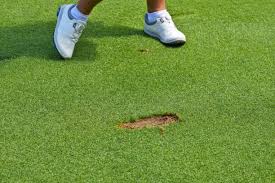
Replace displaced turf and press down. Repair ball marks on the putting green; this may be done at any time. Tamp down any spike marks after your group has completed putting. This is your course. THE DIVOT YOU DO NOT REPAIR TODAY MAY BE THE ONE YOU LAND IN TOMORROW.
Be careful when laying down your bag or the flag stick such that no damage is done to the putting green, or, especially close to the hole, by leaning on your putter or removing the ball from the hole with your putter.
Place pull and power carts to the side or rear of the green, being careful not to go between the green and bunkers.
Keep your power cart away from tee boxes, and about 30 feet away from the edge of the greens. Signs near the green might say, “No carts beyond this point,” or arrows might point to the cart path. Do not drive close to water hazards, grassy mounds or bunkers. The water can damage the cart, and the cart can damage the mounds and bunkers.

A considerate golfer does not drive a powered cart close enough to the group ahead to interfere with their putting or teeing off.
Please adhere to the 90-degree rule or cart path only rule. Check with the Pro Shop before heading out!
Suggestions for Speeding Up Play

- Keep an extra ball in your pocket – different color, brand or number. It is wise to mark all of your balls.
- In regular Sweeps, play ready golf. In Match play use honors.
- To prevent lost balls, help watch your teammate’s and competitor’s shots.
- Determine club selection while others are playing, in anticipation of your next shot.
- Avoid excess practice swings.
- When sharing a power cart, the player not hitting should walk to her ball and be ready to hit. Take more than one club with you in anticipation of the shot.
- Except in Match play, use continuous putting when possible. Leave the green as soon as possible.
- Study your putt before it is your turn, and putt without delay.
- Leave the green and move to the next tee as soon as possible. Enter your score at the next tee.
- If you are falling behind, discuss the situation with your group and take remedial action to catch up or call the following group through.
Course Etiquette

Golf is a game of great traditions, among the first being etiquette. The Royal and Ancient Club of St. Andrews, where golf originated in 1457, issues the following guidelines:
- No one should move, talk, or stand close to or directly behind the ball or hole when a player is address the ball or making a stroke.
- Play without delay. Keep up with the group ahead, being careful not to play until they are out of range. Have your club ready. There is no penalty in stroke play for playing out of turn from the teeing ground or elsewhere. To speed up play, the player reaching the tee box first should tee off. When two balls are hit approximately the same distance, but are on opposite sides of the fairway, the player who reaches their ball first should hit first, as long as she is not endangering another player and is not in danger of being hit herself.
- Players searching for a ball should signal players behind to pass as soon as it is determined that the ball will not be easily found. Do not wait three (3) minutes before doing so.
- A slow play penalty will be assessed to each member of the offending group, if there are four or more complaints voiced to the Tournament Chair, and if the time elapsed has exceeded four hours, fifteen minutes from tee-off time.
- Leave from the rear of the green and record scores on the next tee.
Dress Code
Use good taste in attire. Halter tops, tank tops, and short shorts (less than 7″ inseam) are not permitted.
Cell Phone/GPS Units
Cell phone GPS units may be used on the course. Electronic communications may be used before the 1st hole, between 9 and 10, and after hole 18. Cell phone can be sued in case of special circumstances. Set your phone on vibrate when expecting a call. Earbuds are not allowed during play. Music, news, podcasts, etc. are not allowed during play.
Winter Rules
Winter Rules are in effect from November 1 through April 1. Winter rules can be implemented or withdrawn at the Tournament Chair’s discretion if conditions allow. It is not mandatory that players take advantage of winter rules and may play the ball as it lies.

A ball may be lifted, cleaned, and placed within one (1) club length within the general area, no closer to the hole. This does not include penalty areas, bunkers or if the ball is OB, or moving the ball from the fringe onto the putting green. The ball no longer needs to be marked prior to using winter rules. Player may place the ball only once; if it subsequently moves after placing, the ball is now in play.
If relief under winter rules is taken correctly, there is no prohibition from moving from rough to fairway or to get from behind a tree or root.
Should a procedural question arise, play two balls and present the question to the Rules and Tournament Chairs before completing your scorecard.
Local Rules
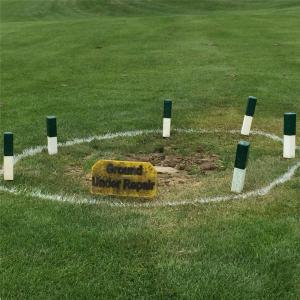
Ground under repair (GUR) should always be a rules committee decision. In a major tournament, unmarked GUR is determined by committee, not players. Proceed using rule 20.1c(3). Play two balls if you are unsure as to whether course damage may be considered GUR.
The drainage swales to the left of holes #6, #7, #8, #9, #10, #12, #13, #14, and behind hole #11 are permanent drainage swales. Except for hole #13, these swales extend from the point where the slope begins to the out-of-bounds fence. Any ball in these areas may be lifted, cleaned, and dropped without penalty at a point one (1) club length out of the swale within one (1) club length of NPR (nearest point of relief). The rule applies if the swale is wet or dry. For hole #13, a player gets NO extra relief from the dirt road or path next to the swale.
Out of bound fences, poles, and stakes are deemed fixed with no free relief (Rule 16.1)
Players receive free relief from the yardage marker bushes/shrubs. The player is permitted to move their ball one club length or distance as needed from the yardage marker to ensure they have adequate space to take a full swing without interference from the marker.
Unplayable Ball Options, Rule 19
If your ball is unplayable, you – and only you – may deem it unplayable and take relief per Rule 19 with a one stroke penalty.
- Stroke and Distance: Play from the position of your previous stroke
- Back of Line Relief: Draw a line from the hole to the location of the original ball. This becomes your reference point. You may go back on this line with no limit. You may drop one club length no nearer the hole in the same area of the course as your reference point.
- Lateral Relief: Two club lengths no closer to the hole and in the same area of the course.
Hole No. Local Rule
- Fence on left is OUT OF BOUND (rule 18).
- Power poles on left mark OUT OF BOUNDS.
- Power poles on left mark OUT OF BOUNDS. Penalty area on right (rule 17).
- Power poles and green fence on left denote OUT OF BOUNDS. A player may decide whether to play the ball or declare an unplayable lie (rule 17).
- Green fence on left marks OUT OF BOUNDS. Penalty area on right (rule 17).
- Black fence on left is OUT OF BOUNDS. Penalty area on right (rule 17).
- Black fence on left marks OUT OF BOUNDS. Penalty area surrounds green (Rule 17). If you are not sure if the ball is in the hazard, send another player to check. A provisional ball from the tee is not allowed.
- Black fence on left denotes OUT OF BOUNDS. Penalty area on left (rule 17).
- Black fence on left marks OUT OF BOUNDS. Pump on left is an immovable obstruction. If it interferes with your stance, lie, or swing you must take no more than one club length from full relief no closer to the hole (rule 16).
- White stakes by parking lot on left marks OUT OF BOUNDS. Driving range on right is OUT OF BOUNDS. Water back of green: use rule 17. If you choose to use the 2-club length option and it puts you closer to the pin, you have an option to use the drop zone between the two trees on the back right of the green.
- Black fence behind green is OUT OF BOUNDS. Penalty area in front of tee (yellow stakes) and penalty area (red stakes) to the right of the tee.
- Black fence on left marks OUT OF BOUNDS. Penalty area on right. Fence protruding into fairway on left is an immovable obstruction if it interferes with your stance, lie, or swing (rule 16).
- Black fence on left and in back of green denotes OUT OF BOUNDS.
- Fence on left marks OUT OF BOUNDS.
- Chain link on left is OUT OF BOUNDS. The rock filled areas surrounded by the cart path behind #15 green and to the left of #16 green are considered an obstruction area. Take free relief under Rule 16.
- Penalty area on right and behind the green. Use Rule 17 options with drop zone as an additional option.
- Chain link on left marks OUT OF BOUNDS. Penalty area on right. Driving range on right enclosed by fence is OUT OF BOUNDS. Brush piles on right are Ground Under Repair, use rule 16.1.
- Fence on left is OUT OF BOUNDS. Driving range on right is OUT OF BOUNDS. If a player’s ball lands in the net, and the nets are on the course side of the posts, a player is entitled to free relief. Drop within one club length no closer to the hole (Rule 17). The white OB Stake next to the far right driving range bay near the netting and the white OB stake next to the railroad tie right of the sand bunker is OUT OF BOUNDS.
NOTE: Cart path loops and turnarounds are considered part of the cart path.
 Davis Women's Golf Club